20% OFF OR MORE WITH OFFER!

SALE ENDS IN

Hrs
Min
Sec

TEXAS DRIVERS LICENSE QUESTIONS

Frequently Asked Questions About Drivers Ed In Texas

Teen Drivers Ed & Parent Participation

  • How Does Parent-Taught Driver’s Education Work?

    Texas Parent-Taught Driver’s Education : A Stress-Free Guide to Your Teen’s License

    With Virtual Drive’s TDLR/DPS-approved Parent-Taught Driver’s Ed course, you can feel confident knowing, “We’ve got this!” From your first step of state registration to receiving your Texas driver’s license, our course provides a smooth, stress-free experience. This approach allows a certified online course to teach your teen, while you supervise and guide their hands-on practice.

    Here’s how it works:

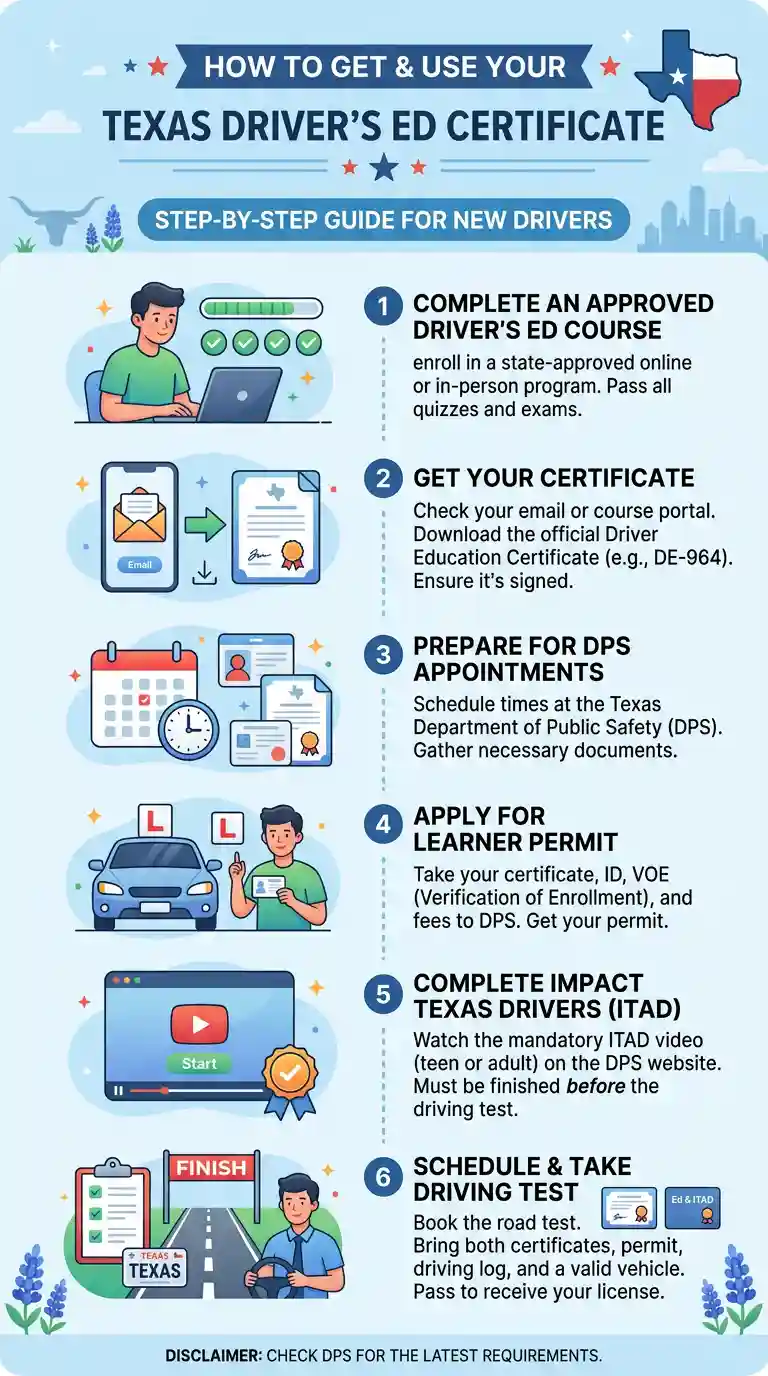
    1. Enroll in the Course: Begin with Virtual Drive’s TDLR-approved Parent-Taught Driver’s Ed course (#107), designed for teens aged 14-17. Complete the DL-92 form and submit it to the Texas Department of Licensing and Regulation (TDLR) to participate in the program.
    2. Study the Online Course: The first six hours of our course focus on preparing for the DPS written test, which you take online with us, allowing for a much easier trip to the DPS in step 3.
    3. Apply for the Learner’s Permit: After completing the first six hours and passing the DPS test, print your certificate, gather your identification (per our checklist provided in the course), and apply for your Texas learner’s license at the DPS office.
    4. Begin Behind-the-Wheel Lessons: With a learner’s permit, teens start in-car driving lessons supervised by a parent or guardian. Teens also continue online course modules until all requirements are completed.
    5. Complete the Impact Texas Teen Drivers (ITTD) Course: All new drivers under 18 must complete the free ITTD course after driver’s ed, a requirement before taking the DPS road test.
    6. Apply for Your Texas Driver’s License: At 16, after finishing the parent-taught course, holding your permit for at least 6 months and completing the ITTD, apply for your Texas driver’s license. Remember to make copies of your DE-964 certificate for insurance discounts and personal records.

    Our program prioritizes ease and clarity to ensure you’re well-prepared and avoid surprises at the DPS. Choose Virtual Drive to experience a Texas driver’s ed program focused on simplicity and support. 

  • How Do We Log Behind-the-Wheel Driving Time?

    The Parent-Taught Driver’s Ed Program Guide from TDLR includes a behind-the-wheel instruction log sheet. Parents sign off on each objective as lessons are completed

    **It is no longer required to submit these hours to the DPS. Our course does provide this form for parents who prefer to keep track with a log sheet, but it is no longer required to submit when applying for a provisional driver’s license. 

  • What is My Role as a Teen Driver’s Ed Student?

    As an online driver’s ed student in Texas, your role is to engage actively in the learning process to build the knowledge and skills for safe, responsible driving. Key aspects of your role include:

    1. Self-Motivation: Stay committed to completing the course by setting study goals and dedicating time to finish each module.
    2. Active Participation: Engage with lessons, watch videos, and complete quizzes to reinforce essential driving concepts.
    3. Follow Guidelines and Deadlines: Adhere to course guidelines, complete modules on time, and follow instructions for assessments.
    4. Seek Clarifications: Ask questions if needed, using available resources to fully understand driving laws and safety practices.
    5. Practice Responsible Online Behavior: Maintain professionalism in interactions with course materials and instructors.
    6. Prepare for Exams: Take assessments seriously by reviewing content, practicing sample questions, and seeking help if necessary.
    7. Apply Knowledge in Real Life: Start relating what you learn to real-world driving scenarios, focusing on responsible driving behaviors. 
  • What Are My Responsibilities as an Online Parent-Taught Driving Instructor for My Teen?

    If you’ve chosen online parent-taught driver’s ed, your role is straightforward. A quality course will guide you and your teen through the required 24 hours of classroom instruction, leaving you to simply monitor progress and sign off on course completion.

    As the in-car instructor, you’ll supervise 7 hours of in-car lessons, 7 hours of behind-the-wheel practice, and an additional 30 hours of driving experience, including 10 nighttime hours. A well-structured course provides prompts and guidance to help you through each step.

    Once completed, bring the required forms to the Texas driver’s license office, sign off on the paperwork, and submit it. You’ll then wait as your teen takes the final driving test to earn their license. 

  • What If I Prefer Someone Else to Teach My Teen Behind the Wheel?

    Now, parents or guardians who prefer not to teach behind-the-wheel (BTW) skills can still enjoy the flexibility of online learning. A recent Texas law allows individuals over 25 with a valid driver’s license—such as a sibling, cousin, or family friend—to conduct BTW instruction for teens. Alternatively, commercial driving schools work with online providers to offer a hybrid approach, combining 24 hours of online classroom instruction with professional in-car training.

    This hybrid model merges the benefits of parent-taught and commercial drivers ed, providing an affordable and flexible option for families who prefer not to handle the BTW instruction themselves. 

  • How Do I Know if I’m Eligible to Be a Parent Taught Driving Instructor?

    The TDLR website provides step-by-step instructions for registering as a parent-taught driving instructor. You can check your eligibility to teach your student here .

  • Does My Teen Need Auto Insurance?

    While your teen holds a learner’s permit, they can be covered under your vehicle insurance as long as they’re still a student and unlicensed. Once they obtain a driver’s license, they’ll need liability insurance in their own name. 

Teen Course Requirements & Timeline

  • How Many Hours Are Required for Parent-Taught Driver Education?

    Teens aged 14-17 must complete 24 hours of online (or classroom) training and 44 hours of behind-the-wheel instruction. Plus a state required 2 Hour “Impact Texas” course. 

  • How Long Does the Parent-Taught Course Take to Complete?

    The duration of the Texas parent-taught driver’s ed course depends on the schedules of both the teen and the parent instructor. Most students finish in about six months. 

    This self-paced course allows teens to progress as their time permits. Many teens choose to study an hour or two per day, while others with busy schedules spread it out over time.

    The behind-the-wheel instruction, led by the parent or legal guardian, is also flexible with no daily requirement. Parents often set aside a few evenings or weekends for these lessons. Find a schedule that works for you and take it step by step! 

  • How Long is Texas Driver’s Education for Teens?

    To complete drivers ed in Texas, teens under the age of 18 must complete their course before their 18th birthday.  This includes 24 hours of online driver education training and 44 hours of behind the wheel driver training with a designated parent or legal guardian.  Students must have held their Texas learners license for at least six months, complete the Texas IMPACT training and pass the DPS road test. Most students complete the full course in 6 months time. 

Teen Permits & Getting Started

  • What Age Can My Teen Begin the Parent-Taught Driver’s Ed Course?

    Students must be at least 14 years old to start the Texas Parent-Taught Driver’s Ed course. However, a learner’s permit won’t be issued until the student is at least 15. Teens under 18 are required to complete an approved driver education course before obtaining a Texas provisional driver’s license

  • How Do I Start Texas Online Driver’s Ed as a Teen?

    Starting online driver’s ed in Texas as a teen involves these steps:

    • Meet Eligibility Requirements: You must be at least 14 to start the classroom portion of driver’s ed.
    • Choose an Approved Provider: Select a TDLR-approved online driver’s ed provider. The Texas Department of Licensing and Regulation (TDLR) lists approved providers on their website.
    • Register and Enroll: Sign up for the Parent-Taught Course, entering details like your name, birthdate, and contact information.
    • Complete the Course: Log in and study modules on traffic laws, road signs, safe driving, and more.
    • Pass the Final Exam: After completing coursework, take a final exam covering what you’ve learned.
    • Receive Completion Certificate: Upon passing, you’ll receive a certificate required to apply for your Texas learner’s permit.
    • Apply for a Learner’s Permit: Visit your local DPS office with your certificate and required ID documents to apply.

    These steps will help you start and complete Texas online driver’s ed and move toward getting your license. Check with the course provider and Texas DPS for any additional requirements. 

  • How Long Until I Can Drive Without a Parent?

    In Texas, you can drive without a parent once you turn 16, have held your learner license for at least six months, completed all required driver education and practice hours, finished the Impact Texas Teen Drivers program, and passed the DPS driving test.

    After passing the road test, you’ll receive a provisional license, which allows you to drive alone. However, restrictions apply until age 18, including limits on teen passengers, late-night driving, and cell phone use. 

Teen Certificates & Documents

  • How Long is My Teen’s Driver’s License Certificate Valid?

    The teen driver’s license certificate (DE964) does not expire, however; the written test completion has a validity time of 2 years. The certificate issued for completing the Virtual Drive of Texas parent-taught driver education course confirms that all requirements for ages 15-17 have been met, including the online test. We suggest getting to the DPS within 2 years of completing the online course to avoid any confusion or need for retesting. 

    **A teen’s permit and/or provisional license will expire on their 18th birthday. 

  • What is the DE-964 Certificate?

    The DE964 is the teen driver education ceritficate issued by the driving school upon completion of teen driver’s ed in Texas. This certificate is essential so make copies for your records. A DE-964 copy must be presented at the DPS office when applying for a Texas provisional driver’s license.

    Learn more about the DE-964

Instructor-Taught Training

  • How Does Instructor-Led Driver’s Ed Work?

    Step 1: Enroll in the TDLR-Approved Instructor-Led Driver’s Ed Course (Sometimes also referred to as the “Self-Paced” Course)

    Begin by enrolling in our TDLR/DPS-approved Texas Instructor-Led Driver’s Ed Course. This course covers all 24 hours of state-required classroom instruction to help teens earn their Texas learner’s permit and driver’s license.

    Step 2: Complete the Online Coursework

    The initial six hours focus on preparing for the Texas DPS written permit test. With TDLR approval, our course includes the DPS test online, saving students a trip to the DPS office.

    Step 3: Apply for Your Texas Learner’s Permit

    After passing the first six hours and the DPS test, print your certificate, gather the required identification, and visit your local Texas DPS office to apply for your learner’s permit.

    Step 4: Begin Behind-the-Wheel Training

    With a learner’s permit in hand, teens can start their behind-the-wheel driving lessons with an approved driving school. The student will continue working through the final 18 hours of online classroom lessons during this time as well. 

    **Make sure to check with your local driving school, many will require the classroom hours to be completed in full before signing up for driving lessons.

    Step 5: Complete the Impact Texas Teen Drivers (ITTD) Course

    Texas requires all drivers to complete the free Impact Texas course after finishing driver’s ed. The ITTD course must be completed before taking the DPS road test.

    Step 6: Apply for Your Texas Driver’s License

    After completing the 24-hour course, required driving hours, and ITTD course (and reaching the age of 16), students can apply for their Texas driver’s license.

    **Keep copies of the DE-964 certificate for insurance and personal records. 

  • What’s the Difference Between Parent-Taught and Instructor-Led Driver’s Ed?

    While both Parent-Taught and Instructor-Led driver’s ed require the same course work and hours, the approach differs significantly. Parent-Taught driver’s ed allows parents to guide their teen’s learning with online tools and resources, providing flexibility for family schedules. In contrast, our Instructor-Led Driver’s Ed course offers a structured, Texas state-approved learning experience, with certified instructors delivering professional, online instructional training. This approach allows the teen to utilize a local driving school for their behind the wheel hours but still allows them to take a course online for learning flexibility. 

    This ensures teens receive consistent guidance and expert instruction to prepare for their Texas learner’s permit and driver’s license. 

  • How Long Does it Take to Complete the Instructor-Led Driver’s Ed Course?

    The time required to complete the Texas Instructor-Led Driver’s Ed course depends on the student’s schedule and pace. Most students finish within four months, though some complete it in as little as two months, while others may take up to six months.

    As a self-paced course, teens can complete the 24 hours of classroom instruction at their convenience, whether dedicating an hour or two each day or working around extracurriculars and other commitments. Upon completing the classroom portion and obtaining a learner’s permit, the student is transferred to the driving school of their choice for 14 hours of behind-the-wheel training, including 7 hours of driving and 7 hours of in-car observation.

    In addition to the driving school’s instruction, students must complete 30 more driving hours with a parent or guardian, including 10 nighttime hours. Although the course requires a significant amount of practice, the six-month permit period provides ample time to complete all driving hours and prepare for the Texas driver’s license test.

  • What Age Can My Teen Start the Instructor-Led Driver’s Ed Course?

    Students can begin the Texas Instructor-Led Driver’s Ed course as early as 14 years old. However, they won’t be eligible for a learner’s permit until age 15. Teens under 18 must complete an approved driver education course to qualify for a Texas provisional driver’s license. 

  • How Many Hours are Required for Instructor-Led Driver Education?

    The Texas Instructor-Led Driver Education course includes the required 24 hours of classroom instruction. It does not include the 44 hours of behind-the-wheel training. These in-car hours are done through your local driving school of choice. Students using the Instructor-Led method of online classroom are still required to complete the 7 hours of in-car observation, 7 hours of driving with a certified instructor, and 30 additional hours of practice with a parent or guardian. These state-mandated hours help prepare teens for their Texas learner’s permit and driver’s license. 

Teen Special Situations

  • What Should I Do If I Started My Course Before Receiving My PTDE Packet?

    Most online driver’s ed courses allow students to revisit completed coursework, and logged hours can be adjusted as needed if you have started your course before getting registered with the state. This flexibility helps you align your schedule with the state’s requirements. The parent can register quickly and online by visiting the parent registration website

    The Texas Parent-Taught Driver’s Education (PTDE) packet confirms that the parent who submitted the (DL-92) request has been approved by the state. Once processed, Texas will send the PTDE packet and update the DPS system with this information. Note that the DPS will only accept logged parent-taught hours from the approval date (the day you receive the packet).  

  • What If I’m About to Turn 18?

    In Texas, licensing requirements differ for ages 14-17 and 18-24. If you’re nearing 18 and have started an online teen driver’s ed course, you must complete it and obtain your certificate before your 18th birthday.

    If time does not allow for you to complete the required teen hours, you can wait until you turn 18 and enroll in our approved adult course, as only the adult course certificate qualifies those 18 and older for a license. 

Adult Driver’s Ed Basics

  • What Should Adults Know About Texas Driver Education Requirements?

    Texas requires adults aged 18-24 to complete a six-hour state-approved adult driver education course and pass the final exam before applying for a driver’s license. This course covers essential knowledge for safe driving and prepares students for the DPS written test. Adults 25 and older, while not required to take the course, can also enroll to take the DPS written exam at home. They then present their course completion certificate at the DPS office before taking the driving skills test.

    Both age groups (18-24 and 25+) must complete the Impact Texas Adult Drivers (ITAD) program, a short online video focusing on safe driving practices, prior to the driving test. Once the adult driver education course and ITAD program are completed, adults can schedule their written and driving exams at the DPS to earn their Texas driver’s license. 

  • What is Texas Adult Driver’s Ed?

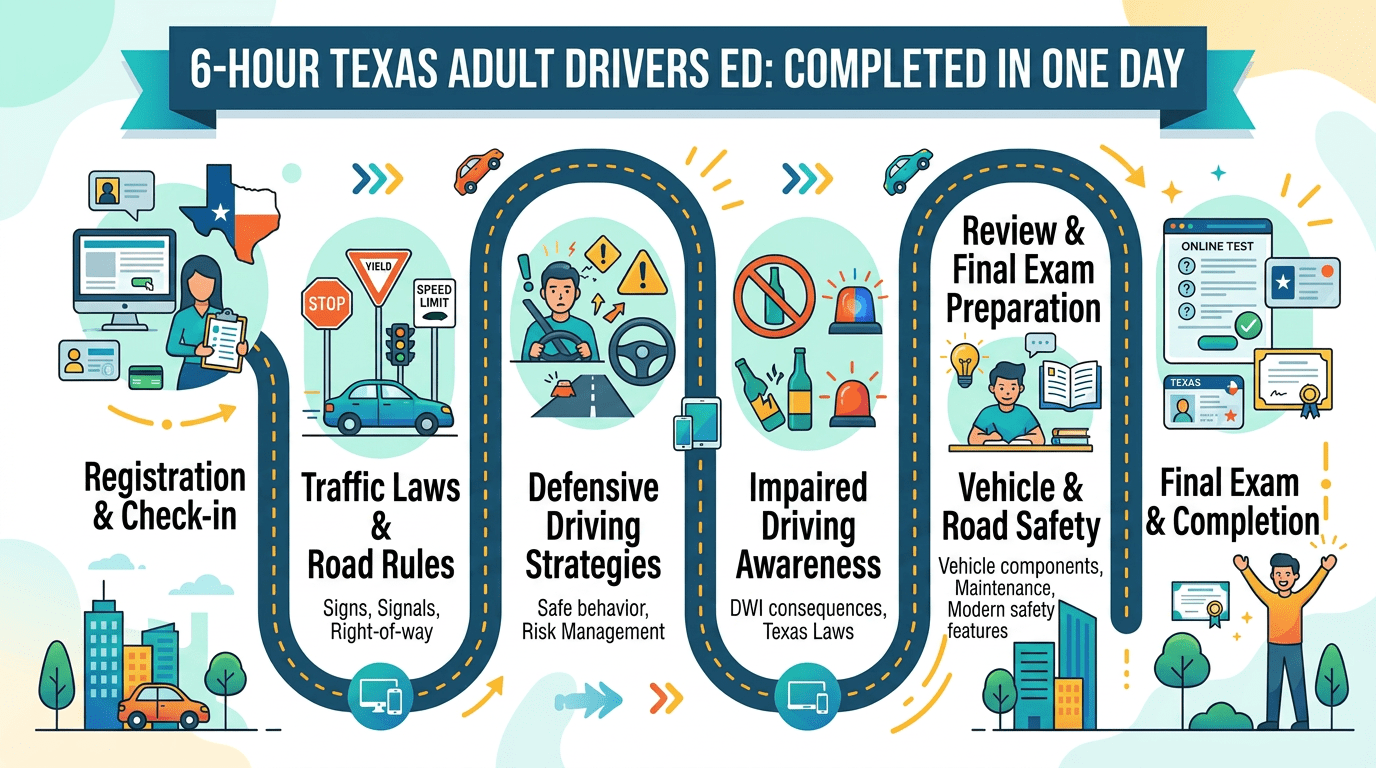
    Texas Adult Driver’s Education is a 6-hour state-approved course required for individuals ages 18–24. It covers traffic laws, road safety, and prepares you for the written knowledge test.

  • What Are the Requirements for Texas Adult Driver Education?

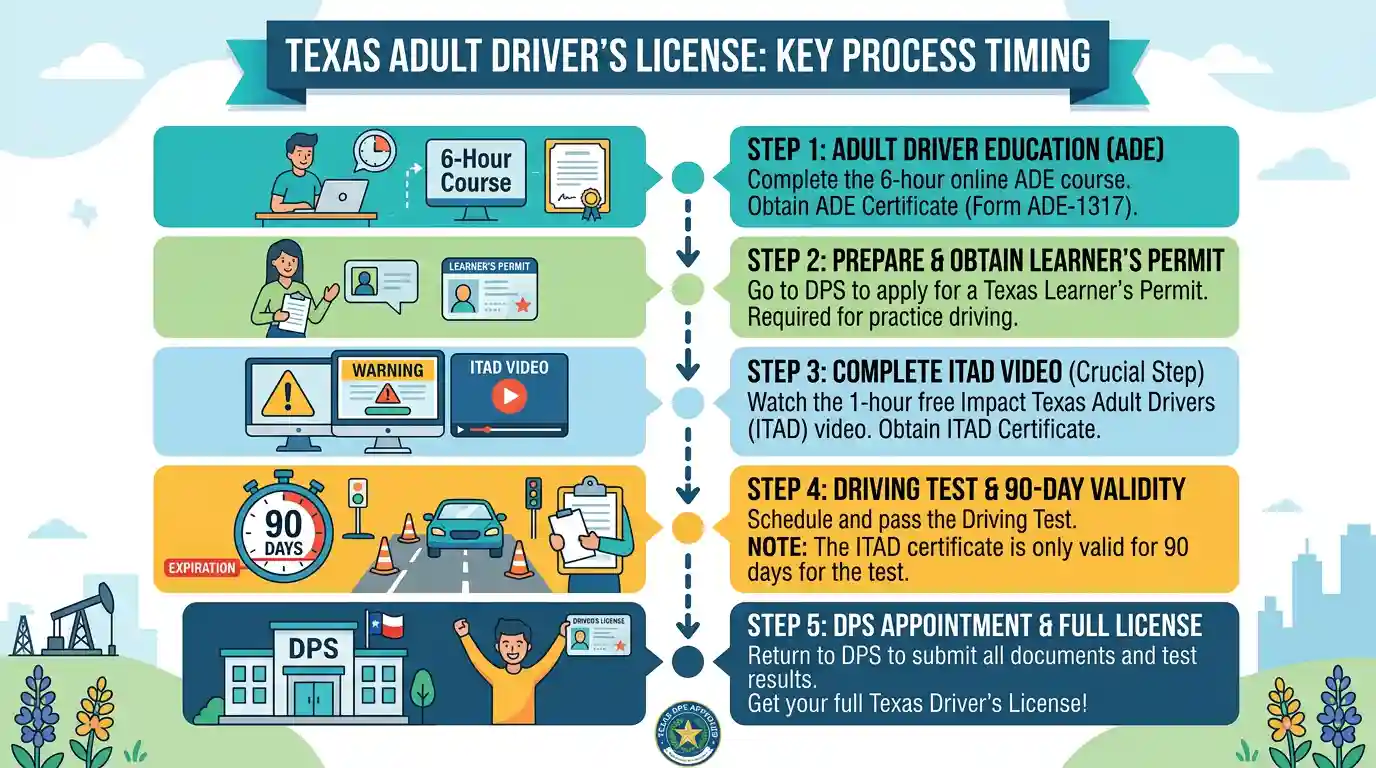
    1 – Enroll in Our TDLR-Approved Adult Driving Course

    Start by enrolling in Virtual Drive’s TDLR-approved Adult Driver’s Ed (approval #C2636). You can start driver training immediately and even complete the course in a day!

    2 – Complete Six Hours of Online Adult Driver’s Ed (Ages: 18-24 Required – 25+ Optional)

    For ages 18-24, Texas law requires six hours of online driver’s ed. Lessons are short and flexible, allowing you to log in and out as needed. (Adults over 25 are not required to take a driving course. Many choose to in order to prepare for the written test and to be able to take the test online instead of at the DPS.)

    3 – Pass the DPS Written Test Online

    The final exam in our course is the DPS written test, which you can take from home. With a 90.4% first-time pass rate, most students succeed on their first try. If needed, you can review and retake the test.

    4 – Print Your ADE-1317 Certificate

    After completing the course and passing the test, you will immediately receive a downloadable ADE-1317 certificate. This can be printed and brought to the DPS when applying for your permit or license. 

    5 – Complete the Impact Texas Adult Drivers (ITAD) Program (required for all adults regardless of age)

    Texas requires all first-time drivers over the age of 18 to complete the free ITAD course. This video must be completed before taking the final road test.

    6 – Apply for Your Texas Learner’s Permit or Driver’s License

    After completing the course, apply for your permit or license at the DPS. You’ll need to pass the road test with a Texas State Trooper to earn your license. If you need practice, you can obtain a learner’s permit to drive with a licensed adult (21+) until you’re ready. 

  • How does adult driver’s education work?

    Texas Adult Driver Education Made Easy

    Texas adult driver education requirements are straightforward. Adults aged 18-24 must complete an adult driver education course. For those over 25, taking the course allows them to complete the final written exam at home. The full program involves:

    • Completing a six-hour adult driver education course and passing the final exam
    • Presenting the course certificate and all required documents at the DPS office
    • Scheduling and passing a driving test at the DPS office

    This is the fastest, most convenient way to get your Texas driver’s license if you’re 18 or older. 

Adult Course Requirements & Eligibility

  • Do I have to take a 6 hour course if I’m 25 or older?

    If you are 25 or older, Texas does not require you to complete a driver education course. However, taking a 6-hour adult driver education course is strongly recommended to prepare for the written and driving tests.

  • Are adults in Texas required to get a learner’s permit?

    In Texas, adults aged 18 and older are not required to obtain a learner’s permit before getting a driver’s license. That being said, many adults do prefer it in order to legally practice drive time before taking the driving test at the DPS or if they want to take the driving test with a Third Party Test Provider.

    Adults who choose this option will receive a Class C – B restricted license. This license is the equivalent of the teen learner’s permit but without the 6 month requirement.  

    When going to the DPS, if you are not ready to take the driving test just yet and want this restriction on your license, let them know and you will be able to get the Class C – B restricted license, take time to practice driving and then return once you feel prepared to take on the driving skills test either at the DPS or through a Third Party Provider . 

  • Are adults required to log driving hours?

    Adults are not required to log driving hours. However, you will need to pass a driving test with an officer. If you’re not fully confident, consider using your ADE-1317 certificate to obtain a Class C- B restricted license first. This restriction is the equivalent of a learner’s permit and allows you to practice with a licensed driver 21+ in the passenger seat before taking the road test for your official Driver’s License. Remember, driving is a serious responsibility. Take your time to build your skills so you can “Drive Safe & Have Another Day!” 

Adult Course Completion & Timing

  • Can I really finish adult driver’s ed in one day?

    Yes, the 6-hour Texas adult driver education course can be completed in one day. However, completing the course is just one step—processing your certificate and scheduling your DPS test may take additional time.

  • How Long is Texas Adult Driver’s Education?

    To complete driver’s ed in Texas, adults 18-24 are required to take a six-hour course. (Optional for 25+) This course can be completed in one day for those who prefer to study consecutively. After the course, students must also complete the Texas IMPACT training and pass the DPS road test. Our course provides guidance on these final steps to ensure a smooth path to your license. 

Adult Permits & Getting Started

  • What is the first step to getting a Texas driver’s license as an adult?

    The first step is to complete a state-approved 6-hour adult driver education course if you are 18–24. Then gather required documents, complete ITAD if applicable, and schedule your DPS driving test when ready.

Adult Certificates & Documents

  • How Do I Receive My Certificate of Completion?

    Simply print your ADE-1317 certificate as soon as you pass the written test! Issued by Virtual Drive after completing the six-hour course, this certificate is essential. Be sure to make acopies, as you’ll need to present one at the DPS office when applying for your Texas learner’s permit or driver’s license.

  • How long is my certificate valid?

    The ADE-1317 certificate is valid for 2 years from the date of issue. 

Adult Testing & DPS Requirements

  • Can I Take the DPS Test Without Completing the 6-Hour Course?

    Texas law does not require formal driver education for adults over 25. If you’re a first-time driver in this age group, the process for getting your learner’s permit or driver’s license is similar to that for ages 18-24, but without a required course. However, our online Texas Adult Driver’s Ed course is the easiest way to prepare for the DPS written test. You’ll get access to essential materials and can complete the DPS written exam online.  

Adult Special Situations

  • What if I’m over 25 and want to get my Texas driver’s license?

    If you are 25 or older, you are not required to take the 6-hour course, but you must still pass the DPS vision test, written knowledge test, and driving test (unless you qualify for an approved exemption). Taking a course can still help you prepare and may allow an online knowledge exam depending on provider options.

General Questions

  • What is an Impact Texas Drivers course and how does it apply to me as an adult or applicant age 18+?

    As a part of the 6-hour Driver Education requirement before taking the skills (behind the wheel) examination, ITAD (Impact Texas Adult Drivers) is a separate mandatory program to be completed within 90 days before the skills examination, (following the 6-hour Adult Driver Education Course for those required to take a course).

    Who needs to complete ITAD?

    All first time drivers over 18 must complete ITAD before the drive test, with the certificate valid for 90 days. Applicants aged 18-24 with a DE-964 from a Teen Driver Education course (24 hours classroom, 44 hours behind the wheel) are also required to watch the 2-hour ITAD video.

    Does the ITAD certificate expire?

    Yes, the ITAD certificate is valid for 90 days. If the drive test isn’t passed within this period, the ITAD program must be restarted.

    Can I watch the 1-hour video in parts?

    Yes, the ITAD video is split into three modules for flexible viewing, with each module needing completion before progressing.

    How do I receive my ITAD certificate?

    Your certificate will be emailed to your registered account and can be printed from the ITAD website under “course overview” and “reprint certificate.”  

  • What is an Impact Texas Drivers course and how does it apply to me as a teenager?

    Impact Texas Teen Drivers (ITTD) is a free, 2-hour video emphasizing the risks of distracted driving, featuring real-life stories of teens affected by fatal accidents.

    This course is mandatory for drivers aged 15-17 completing a parent-taught or minor driver education course.

    Completion of ITTD is required after behind-the-wheel driver education and before taking the driving skills test. A completion form from the Impact Texas course is needed to get your driver’s license and must be completed within 90 days of taking the driving test, but after completing driver education. 

  • What is defensive driving?

    Defensive driving is a proactive driving technique that emphasizes anticipating and responding to potential hazards on the road to prevent accidents. It involves using safe driving practices and being aware of your surroundings to minimize risks. Defensive driving courses teach these skills and techniques to help drivers become more cautious and prepared on the road, ultimately enhancing safety for themselves and others. 

  • Is Defensive Driving mandatory for ticket dismissal in Texas?

    Defensive driving is not always mandatory for ticket dismissal in Texas, but it is often a preferred option. In many cases, completing a state-approved defensive driving course, like ours, can be used to dismiss a traffic ticket and prevent points from appearing on your driving record. However, eligibility requirements and specific court policies vary, so it’s essential to check with the court handling your ticket to determine if defensive driving is an option for dismissal. If eligible, completing defensive driving can be a beneficial way to resolve a traffic violation while improving your driving skills and potentially earning insurance discounts. 

  • Which Texas state approved online Defensive Driving or Traffic Ticket Dismissal course is the best?

    While we are partial to the popular courses offered here at Virtual Drive of Texas and we pride ourselves on driver safety and our high passing rates, when looking for the best Texas state-approved online defensive driving course, consider factors like course quality, affordability, and convenience. Of course our school is TDLR-approved and offers a user-friendly online platform with engaging content and interactive features. It allows you to complete the course at your own pace from any device. 

  • What are the benefits of taking an online defensive driving course in Texas?

    Taking defensive driving in Texas offers several benefits:

    1. Ticket Dismissal: Completing a defensive driving course can dismiss a recent traffic ticket, preventing it from affecting your driving record and potentially leading to increased insurance rates.
    2. Insurance Discounts: Many insurance companies offer discounts to drivers who complete defensive driving courses, leading to savings on your auto insurance premiums.
    3. Skill Enhancement: Defensive driving courses teach advanced driving techniques that enhance your ability to anticipate and respond to potential hazards on the road, making you a safer driver.
    4. Point Reduction: Completing defensive driving can result in a reduction of points on your driving record, which helps maintain a clean driving history and avoid license suspension.
    5. Court Requirement: In some cases, a court may require or recommend defensive driving as part of resolving a traffic violation or offense.  
  • Can taking defensive driving reduce my Texas auto insurance rates?

    Yes, taking defensive driving in Texas can often lead to a reduction in your insurance rates. Many insurance companies offer discounts to drivers who complete a state-approved defensive driving course. By demonstrating your commitment to safe driving practices and risk reduction, you may qualify for a discount on your auto insurance premium. It’s recommended to check with your insurance provider to confirm the specific details and eligibility criteria for obtaining a discount after completing defensive driving. 

  • How long does online defensive driving take in Texas?

    Online defensive driving courses in Texas typically take 6 hours to complete. This duration is mandated by the Texas Department of Licensing and Regulation (TDLR) for ticket dismissal purposes. However, the course is self-paced, allowing you to complete it at your convenience within a certain timeframe, such as 90 days from the date of registration. Completing the course within this timeframe enables you to dismiss a traffic ticket and potentially earn an insurance discount. 

  • How do I dismiss a traffic ticket in Texas?

    To dismiss a traffic ticket in Texas, you can typically complete a state-approved defensive driving course. Here’s how:

    1. Confirm Eligibility: Ensure you meet the eligibility requirements to dismiss your ticket through defensive driving. Generally, you must have a valid Texas driver’s license and not have taken a defensive driving course for ticket dismissal within the past 12 months.

    2. Request Permission: Request permission from the court to take a defensive driving course. This can usually be done by submitting a request either in person or by mail.

    3. Enroll in an Approved Course: Enroll in and complete a Texas-approved defensive driving course. (We like to recommend ours.) Make sure the course is certified by the Texas Department of Licensing and Regulation (TDLR) for ticket dismissal. Of course the defensive driving products from Virtual Drive of Texas are approved.

    4. Complete the Course: Successfully complete all requirements of our defensive driving course, including any quizzes or exams.

    5. Submit Completion Certificate: Obtain a completion certificate from the defensive driving course provider. Submit this certificate along with any required documents to the court within the specified deadline.

    6. Follow Court Instructions: Follow any additional instructions from the court, such as paying court fees or submitting paperwork, to ensure your ticket is dismissed successfully.

    By following these steps and completing an approved defensive driving course, you can often dismiss a traffic ticket in Texas and avoid points on your driving record.

  • ¿Cuál es el mejor curso de educación vial aprobado por el estado que se ofrece en español?

    Nuestro curso de educación vial en línea en español, de primera categoría, ha sido muy popular. Está aprobado por el estado de Texas y promueve el aprendizaje de forma segura, rápida y cómoda desde casa. Aprende a conducir con el Curso de Español para Adultos de Virtual Drives.

  • Which is the best online driver’s ed school in Texas?

    While any online course you ask will tell you it’s them, we feel very strongly about Virtual Drive being the best online driver’s education provider in Texas. Virtual Drive of Texas was the first to bring online driver’s education to our state. We are a family run business, with all employees residing and working in Texas, with safety and a high pass rate as our top two goals. While there are many online driver’s ed courses to choose from, none have been in the business as long as Virtual Drive. For all your need-to-know questions, check out our comparison chart

  • How much is a driver’s ed course in Texas?

    Although driver’s education in Texas is not offered free of charge, the cost of courses can differ significantly. Prices vary depending on the type of license sought and can be viewed on the respective course websites. Our pricing is designed to remain competitive within the market, and we continuously update it to ensure it remains current and affordable.

  • How long is a driver’s ed course in Texas?

    The Texas Online Driver Education program covers the mandatory 24 hours of in-class training necessary for driver’s education. Upon completion of this course, students can choose to fulfill the remaining 44 hours of required behind-the-wheel training either alongside an eligible parent/guardian or through a certified driving school instructor. This flexibility allows students to meet the full training requirement conveniently and efficiently. 

  • What’s the difference between a Texas ID and a Texas driver’s license?

    A Texas driver’s license is not only a document demonstrating authorization to drive but it is also a nationally accepted form of identification that can be used to prove your identity. The Texas State ID is only used as an identification card.

    You can learn more about the states Real ID requirements here .

  • What’s the difference between a driver’s license and a driver’s or learner’s permit in Texas?

    The difference between the learners permit and driver’s license is pretty simple, but does depend on the applicants age.

    For teens (15-17):

    A permit only allows you to drive with a licensed driver, 21 or older, in the front passenger seat. This permit must be held for at least 6 months before eligibility for a license becomes possible.

    In order to receive a provisional driver license in Texas, you must be 16 years of age, have held the permit for at least 6 months and met all DPS requirements (including passing the driving test).

    For adults (18+):

    Adults are not required to get a permit when going to the DPS. They have 2 options:

    • Go directly to the driving test and walk away with a driver license upon passing that test. 
    • Put off the driving test until ready and begin with a permit type driver license. In this case they will be issued a Class C- B restricted license to begin with until they are ready to complete the driving test. This restriction acts similar to the teen learner’s permit by requiring a licensed driver 21 or older in the front passenger seat, but does not have the same 6 month holding restriction.

    Once the adult is ready to take the driving test, they can go to the DPS or find a local Third Party Test Provider and upon passing the driving skill test, receive the final unrestricted driver license.  

  • Do I need a permit to get my drivers license in Texas if I’m over the age of 18?

    While new drivers in Texas under the age of 18 are required to apply for a Learner License, once you pass your 18th birthday, this is no longer a required step toward getting your drivers license.

    One of the most common questions we are asked is “Can I get my license at 18 without a permit in Texas?” And the answer is yes! 

  • What age do you have to be to get a learner’s permit in Texas?

    For teens, one of the first requirements is completion of a driver education course. You can begin the classroom phase of a driver education course at 14 years of age, but you cannot apply for a learner license until you are at least 15 years of age. 

  • What documents do I need to bring to the DPS for my driver’s license?

    You’ll typically need proof of identity, Social Security number, Texas residency documents, driver education completion certificate (if required for your age), and any DPS application forms. Document lists vary by age and situation—confirm requirements for your appointment before you go.

Online Education Options & Benefits

  • Compare Online Driver’s Ed – Parent-Taught vs. Online Commercial Driver’s Ed

    What is the difference between Online Parent-Taught and Online Commercial drivers ed? 

    We like to view the motto for the Parent-Taught industry as “WE’VE GOT THIS,” but the reality is that some parents would just feel more comfortable having their student learn the hands-on experience of traffic school from a professional.

    We partner with commercial driving schools so they can provide online drivers ed to their students in order to maintain the simplicity and freedom of learning from a mobile classroom experience. These schools have joined us in our passion for making drivers ed a fun and retentive experience where we’re created a hybrid course that allows commercial schools to join us in our motto of “WE’VE GOT THIS.” 

    If you are interested in learning the classroom portion online but prefer to do the behind the wheel hours through a driving school, consider our instructor-led course .

    If you are a Commercial Driving School interested in partnering with us, please let us know! We’d love to team up. Email us at contact@vdriveusa.com

  • What is the difference between concurrent and block methods?

    The difference between concurrent and block teaching methods of driver’s education courses relates to how the classroom and behind-the-wheel (BTW) instruction components are structured and scheduled:

    Concurrent Method:

    • In a concurrent driver’s education course, the classroom instruction and BTW training are typically conducted simultaneously or concurrently. This means that students receive both classroom education and practical driving instruction concurrently throughout the duration of the course.
    • Students often attend classroom sessions on certain days or weeks while also participating in behind-the-wheel training during the same period.
    • This method can be more intensive and immersive as students engage in both theoretical learning and hands-on driving experience concurrently.

    Block Method:

    • In a block driver’s education course, the classroom instruction and BTW training are separated into distinct blocks or segments.
    • Students complete the classroom portion of the course first, which may involve attending daily or weekly sessions over a set period of time (e.g., several weeks).
    • After completing the classroom component, students then proceed to the behind-the-wheel training phase, which is typically scheduled separately and may involve a concentrated period of driving lessons.
    • This method allows students to focus exclusively on classroom learning initially before transitioning to practical driving instruction.

    Key Differences:

    • Structure: Concurrent courses integrate classroom and BTW instruction concurrently, while block courses separate these components into distinct phases.
    • Timeline: Concurrent courses may have a more overlapping or intertwined timeline for classroom and driving instruction, whereas block courses follow a sequential timeline with separate phases.
    • Intensity: Concurrent courses can be more intensive as students balance classroom learning with driving practice throughout the course duration. Block courses may allow for more focused and concentrated learning in each phase.

    The choice between concurrent and block methods often depends on factors such as student preferences, scheduling flexibility, availability of instructors, and educational objectives.

    (If you plan to use a local driving school for your behind-the-wheel learning, check with them ahead of time to see if they require a specific method.)

  • How does online compare to commercial classroom driving schools in Texas?

    The first thing that comes to mind is how involved must a parent be in their child’s driver’s ed process. The idea of a commercial driving school is to allow a professional to take on the initial responsibility of providing your child with what is needed to be a safe driver.

    What most parents in Texas don’t know is that the majority of the driving, no matter the method, must still be carried out by the student’s primary guardian. This means that out of the 44 hours of driving expected from the student, 30 of those hours are still being administered by, most likely, the parent.

    The myth that commercial driver’s ed classrooms are all-encompassing, removing the parent from responsibility over their student’s driving experience is just that, a myth. Online driver’s ed, whether it be parent-taught or commercial, provides the parent the ability to achieve the same peace of mind in professionals to the same extent achieved through the commercial classroom route alone. The introduction of hybrid online commercial schools has helped to bridge the gap created by these two industries. 

  • Are there any additional instructional aids or study tools?

    Repetition and challenging yourself are the most promising ways to ensure the confidence needed to succeed. Practice tests provide an excellent opportunity to not only test what you have learned but also become familiar with the type of questions you might see on the final examination. Additionally, in-car video tips can help prepare the parent to understand the style and flow of how most parents conduct their behind-the-wheel training.

    If you would like more details on our supplemental training options, please check out the links below.

  • How do I teach online driver’s education?

    This process can be as simple as pushing the next button. It also can be as difficult as spending days organizing and collecting state information to compile a comprehensive educational curriculum. The reason online driver’s ed has grown at such a substantial rate is the ever-growing convenience that it provides. The driver education process in Texas is just that, a process, which means there is a step-by-step experience that your course should, with simplicity and ease, manage to get you through without ever having to ask this question. If your online driver’s education program doesn’t provide you this peace of mind, then question the quality of your product. 

Driver's License Guides & Courses

  • How many tests do I need to take for a Texas driver’s license?

    3 major examinations make up the driver’s education process.

    • The first tests the student’s understanding of the beginning 6 hours of curriculum to obtain the learner’s permit.
    • Second, comes the final classroom examination administered once all 24 hours of classroom study have been completed. 
    • Finally, there is the in-car examination carried out by a DPS official at the time of acquiring the Texas license.

    Classroom examinations can be taken on at the DMV. However, most online courses in Texas, including Virtual Drive, provide their students with classroom exams through the online course itself. 

  • Can the Department of Public Safety (DPS) learners and license test be taken through the course?

    Yes, both DPS classroom exams are available to take through the online course itself. Completion of these exams with a passing grade provides you with the proper state verification of exam completion. This means that your final test can be taken anywhere you find to be a comfortable environment. 

  • What are the steps for getting my Texas driver’s license?

    Parent-Taught Steps to getting started and obtaining your learner’s permit and driver’s license.

    First things first, make sure you are qualified to teach the parent-taught method. You can find out here .

    Step 1: Learner’s Permit

    1. Purchase your desired online driver’s ed course.
    2. Complete the state-required (DL-92) application for the Texas PTDE (Parent Taught Drivers Education) Packet. **Not sure if you’ve done this or need to do it now? You can register or check your status here .
    3. Once the PTDE packet has been received, the student may then, and only then, begin the first 6 hours of the course required to obtain their learner’s permit. 
    4. After completion of the first module (the first 6 hours), the student will then take their learner’s permit test. This test will most likely be provided by the course you choose; however, you also have the option to take the test at the driver’s license office.
    5. Now that the requirements for the permit are complete, it is time to gather your paperwork and head to the driver’s license office. The list includes:
    • Verification of Enrollment Form (get it here) – You must have received this within the last 30 days before going to the DPS. This comes from your public or private school. Homeschoolers will have their parents sign.
    • DL-14A (get it here) – Application for Driver License – You can fill this out before going or wait until you get to the DPS. But DO NOT sign yet, the DPS office will verify your signature.
    • Birth Certificate (Original)
    • Social Security Card
    • Proof of Residency – The parent must show 2 forms of proof of residency.
    • DE-964E Form – This is your certificate of completion for the first 6 hours of your 24 hours of coursework. (The Learner’s Permit section of the course) **You will receive a second certificate at the end of the 24 hours when it is time to get your final Driver’s License.

    Step 2: Driver’s License

    Acquiring the learner’s permit means you are now eligible to begin the second step of the classroom work for the Driver’s License, along with the “Behind-The-Wheel” lessons that correspond with what the student has just learned. It is also possible for you to follow the block method of learning. This requires completion of the full classroom before beginning any hands-on work.

    • At this point, you will continue following your course’s design until you have completed the final 18 hours of online classroom lessons and the 44 hours of behind-the-wheel lessons and practice hours. There will be course content, worksheets, and quizzes throughout that must be completed to move on to the final exam.
    • The final written exam is solely based on the classroom work. Even if the driving has not been finalized, the final exam can still be taken.

    Going Down To The DPS

    The completion of the final exam with a passing grade of 70 or higher means the end of your classroom requirements. Once the driving lessons and experience hours have been completed, the 6-month permit requirement has been met, and the student is 16 years old, you are ready for the driver’s license office.

    Here is what you will need for your DPS visit:

    • DE-964 (Completion Certificate)
    • DL-14a (Driver’s License Application)
    • Impact Texas Teen Drivers (ITTD) certificate
    • Proof of identity (passport or birth certificate)
    • Proof of Social Security number
    • Two proofs of Texas residency
    • VOE (Verification of Enrollment)
    • Proof of passing the driving test (if taken with a third party)
    • Application fee 
  • Would I qualify to get my license early?

    To answer this question, you would first need to answer one of the following questions with a “Yes”:

    • An unusual economic hardship for the family of the minor.
    • A death-related emergency.
    • Sickness or illness or disability of family members. (PHYSICIAN’S STATEMENT REQUIRED)
    • Enrollment in a Vocational Education Program. (CERTIFICATION FROM SCHOOL REQUIRED)


    If you meet any of these scenarios and would like to apply to the state, Please download the DL-77 .

  • How long does it take to receive my Texas driver’s license certificate?

    This process is instant with Virtual Drive and should be instant, if not at least same-day delivery for most others.

    The state of Texas changed the requirements for a driver ed certification to be hard copy. This began allowing for digital copies to be used, and the long waiting game came to an end. Now, our course provides you with immediate satisfaction once your final test has been completed with a passing grade. 

  • How long does it take to get my Texas driver’s license?

    This question can be answered in two ways:

    Technical answer:

    1. 6 Hours of the Learner Permit Classroom are required to receive the permit.
    2. 18 Hours of post-permit classroom to receive the final course completion certificate.
    3. 14 Hours of Behind-The-Wheel training.
    4. 30 hours of experience driving (10 of which are at night).
    5. 68 total hours must be completed to receive the Texas driver’s license.

    The parent instructor can teach a maximum of 2 hours of behind-the-wheel driving instruction per day. However, up to 4 hours of total in-car training (including observation) can be counted per day, as long as the behind-the-wheel instruction doesn’t exceed two hours. If you and your student plan to do both online and in-car instruction on the same day, the total time must not exceed 6 hours per day, with no more than 2 hours of behind-the-wheel practice.

    The reality is that many students and parents tend to have other life priorities take precedence. The main reason someone takes online driver’s ed is to create flexibility in their life. No one wants driver education running their schedule. That’s just part of it, life happens. 

    The permit must be held for at least 6 months and until the student is 16 years old.

    This means that all students must wait at least 6 months before they can even receive their Texas driver’s license. Feel free to spread the hours of learning throughout that 6-12 month(s) in whatever schedule fits your needs.  

  • How long until I can get my Texas driver’s license?

    Simply put, 6-12 months, depending on if you are under the age of 18 years old.  No matter how you break down your coursework, you are still required to hold your permit for at least 6 months after receiving your learner’s permit.  You must also be 16 years of age unless you qualify for a hardship license. Apply by filing the state form DL-77 .

  • Are the tests timed?

    No, all aspects of online driver’s ed are designed to create stress-free and comfortable environments for learning, as well as testing. Forcing time restraints on something as crucial as final examinations would not provide that crucial element of peace while completing each step of your education. Virtual Drive students have 3 attempts to pass each test, giving them plenty of ability to achieve a passing grade. 

  • How do I receive my driver’s ed certificate of completion?

    The certificate of completion should be a digital copy that becomes available once the final examination has been completed. Just as with the rest of your course, the step-by-step layout of your course will prompt you on when and how to receive the certificate. At Virtual Drive of Texas you can choose to print the certificate or find out whether your local DPS office will accept an emailed copy. 

  • Do I need more than one copy of my driver’s license certificate?

    Yes. Not only is it a good idea to have a spare copy of your certificate for your sake, but there is also the likelihood that your insurance will ask for a copy to qualify you for their teen driver discount. Cost should not be an issue considering your certificate is printable; leaving you free to print as many copies as you might need. 

  • Where do I go to get my Texas driver’s license?

    You will visit the Texas Department of Public Safety once you are ready for either the permit or license. The Texas DPS manages the license given out to each new driver. It is not a requirement to go to the DPS of your resident county to complete the driver’s license process. Check out our Texas DPS information page to find out more about the department and locations. 

DPS Basics

  • What is the Texas DPS?

    Texas Department of Public Safety (DPS) – The DPS is where you will go to receive your permit and/or driver license. It provides important information on obtaining a Texas driver’s license, including the requirements for the written and road tests, scheduling your road test, and information about the Impact Texas Teen Drivers (ITTD) course. 

DPS Appointments & Locations

  • How Do I Avoid Lines at the Driver’s License Office?

    Texas recently launched new technology that allows you to “Get In Line” via text messaging. You simply take your place in the queue and then are free to handle other business while you wait. The system will send you a text when it is your turn. This will give you more time to study or clear your mind before taking the DPS written test.

    To determine if your local office offers the Get In Line service, visit the Mega Center DPS Appointments . If you are going to one of the offices which does utilize this technology we highly recommend that you take advantage of it. If you do not have a phone that has text capabilities, do not worry. You can still use the traditional paper ticket method to reserve your spot. 

  • How do I schedule my road test?

    Ready for your test? Schedule your road test at the Texas DPS website or find an approved Third Party Skills Test School .  

  • Can I Schedule a DPS Appointment in Advance?

    You may be able to avoid long lines to get your Texas learners permit or drivers license at the DPS by scheduling your appointment in advance. Not all offices offer advanced scheduling so it is best to find the location nearest you and see if they can accommodate you. Many of our students find the advanced appointments to be very helpful in scheduling their driving test and making sure it fits in their schedule.

    If you’re ready to get your drivers license you can schedule your DPS appointment here.  

  • Where is the nearest DPS location?

    Texas DPS locations are based on regions and counties. There are a total of eight (8) regions. Since Texas has 254 counties, not all of them will have a drivers license office so you may have to travel to take your test. The best way to find the closest local DPS office is by using the Texas DPS Location Search Tool.

    Remember to call first! Occasionally, the State of Texas endures budget reductions and reallocation that can temporarily or permanently close DPS offices in rural areas. Calling ahead will ensure you do not arrive at a facility that is no longer operational. 

DPS Test Prep

  • How can I prepare for the Texas driving test?

    Review the Texas Driver’s Handbook, practice driving skills like parallel parking, lane changes, and general observation. Many find it helpful to take a mock driving test with a licensed driver to get comfortable with the test format. Add an extra layer of confidence by taking our DPS Test Prep mini course!  

    The DPS also offers this checklist to make sure you’re prepared before your driving test: How to Prepare for a Drive Test 

  • Do I need to parallel park in the Texas driving test?

    Yes, parallel parking is a required part of the Texas driving test. Practicing parallel parking is essential, as it’s one of the main skills evaluated. 

  • What happens if I fail the driving test?

    If you fail, you can reschedule another test. You may have to wait a few days before your next attempt. DPS allows up to three test attempts before requiring additional driver education. 

  • Can I fail the test for making small mistakes?

    Yes, but small mistakes (like minor lane drifting) may not immediately cause failure. Texas DPS scores based on accumulated errors, and you may still pass with a few minor mistakes. However, critical errors like failing to yield or excessive speeding may result in automatic failure. 

  • Do I need to bring a licensed driver to the test?

    Yes, if you’re under 18 or driving there with a learner’s permit, you’ll need a licensed adult (21 or older) with you to drive you to and from the test. 

  • How long does the Texas driving test take?

    The test generally takes around 20-30 minutes. Plan to arrive early for check-in and a quick vehicle inspection by the examiner.

  • What skills are tested in the Texas driving test?

    The test typically includes basic vehicle control, parallel parking, lane changes, obeying traffic signs, yielding, and general observation and awareness. You may also be asked to demonstrate safe turning and stopping distances. 

  • How do I schedule a driving test with the Texas DPS?

    You can schedule a test appointment online through the Texas DPS website or by calling your local DPS office. Some locations also accept walk-ins, but an appointment is highly recommended. 

  • What do I need to bring to my driving test appointment?

    You’ll need to bring a valid learner’s permit, proof of completed driver’s education (if under 25), proof of identity, vehicle insurance, vehicle registration, and a vehicle that meets all safety requirements. 

Defensive Driving & Ticket Dismissal

  • Who is eligible to take an online defensive driving course in Texas?

    Most Texas drivers can take an online defensive driving course to dismiss a traffic ticket if the offense qualifies and the court approves it. Drivers may also complete the course voluntarily to earn insurance discounts or improve driving skills. 

  • How can I find out if I’m eligible to take a defensive driving course to dismiss my ticket?

    Contact the court listed on your ticket for permission to enroll in a defensive driving course for ticket dismissal. 

  • What do I need to do to pass the Texas online defensive driving course?

    You’ll need to complete the six-hour course, pass the quizzes, and finish a final exam with a passing score. Once completed, the course provider will send you a certificate to submit to the court. 

  • How long is the online defensive driving course?

    Texas law requires that all defensive driving courses be at least six hours long, but you can complete it at your own pace, logging in and out as needed. 

  • Is the Texas Defensive Driving School course state-approved?

    Yes, the Texas Defensive Driving School is approved by the Texas Education Agency and accepted by all Texas courts for ticket dismissal. It can also reduce insurance rates by up to 10%—check with your insurance provider for details. 

  • Does the Texas Defensive Driving School course have an expiration date?

    Yes, you have 90 days from registration to complete the course. After that, your registration will expire. 

  • Can I pause the course and resume it later?

    Yes, you can complete the course at your own pace, logging in and out as needed. The course saves your progress automatically, so you’ll resume right where you left off. You have up to 90 days to finish the entire course. 

  • Can I take this course for a Texas ticket if I don’t live in Texas or have a Texas driver’s license?

    Yes, you can take the course. However, if you don’t have a Texas driver’s license, Texas law requires you to submit a notarized Statement of Assurance. After registering, you’ll receive instructions to print the form from our website, complete it, have it notarized, and then send it to Texas Defensive Driving School by fax or mail. 

  • How often can I take defensive driving for ticket dismissal in Texas?

    Eligibility depends on the court and your driving history. Many courts require that you have not taken a defensive driving course for ticket dismissal within the prior 12 months, but you must follow the instructions on your citation and confirm with your court.

Renewal of Existing Licenses or Certificates

  • Where can I go to renew my driver’s license?

    There are two ways in which you can get your driver’s license renewal.

    1. The first is going to be the good old fashioned way. Find the location of your closest DPS and give it a visit. Maybe you’re getting your license for the first time. You might even be trying to get a driver’s license renewal. If this is the case then you’ll likely be using this option.
    2. The more convenient option when renewing your license is to just visit the State DPS Website on Renewals. Here you will find a simple step-by-step process that can help you get a new license, fast and easy. Thank you state of Texas.


  • What do I need to renew my Texas driver’s license?

    At Virtual Drive of Texas, we suggest this list of things you will need when renewing your license at the DPS.

    1. Your current driver’s license or identification card (the one you are renewing);
    2. A printer to print your temporary driver’s license and payment receipt if you renew online. A temporary receipt will not be emailed to you. No receipt will be issued when renewing by phone;
    3. A valid credit card: MasterCard, Visa, Discover or American Express only; and
    4. The last four digits of your Social Security Number.


    1. For more information regarding the Texas DPS License Renewal requirements, please Click Here! 
  • I’m from out of state. How long until I need a driver’s license renewal in Texas?

    Welcome drivers from California, Florida, New York, Illinois, et. al. The state of Texas recognizes reciprocity.

    This means having a valid, non-expired license from any recognized sovereign location grants you one year of driving status. This year of expiration only ends early if you obtain citizenship within that year. In that case, you must complete the entire driver’s license process to receive your Texas license upon citizenship. For more information regarding the state of Texas and out-of-state licenses, please visit the DPS website. 

  • When is my driver’s license up for renewal?

    The driver’s license renewal question can be a bit tricky, so let’s see if we can straighten it up for you. The circumstance that truly defines this question is your age.

    DRIVERS 17 AND YOUNGER

    All drivers under the age of 18 years old must renew their license every birthday until they are 18 years old.

    DRIVERS BETWEEN THE AGES OF 18 AND 84

    All drivers between the ages of 18 and 84 are subject to a 6-year license term. That term is based on the driver’s birthday within the issuance year. This means if you renew your license two weeks later than your birthday, the license term is 6 years minus one week. There is also the likelihood that drivers at the age of 21 will voluntarily renew their licenses early. One restriction that will stay on your license in Texas until you are 21 is the underage identifier. This tends to bother some who are no longer underage, leading them to get their license renewed on their own.

    DRIVERS 85 YEARS AND OLDER

    1. Drivers 85 years of age or older are subject to a shorter expiration period on their license. Once a driver hits the age of 85, they are expected to renew their license every 2 years. 
  • Can I renew my Texas driver’s license online?

    Many drivers can renew online if they meet DPS eligibility requirements (such as age, license status, and having a current photo/signature on file). If you’re not eligible online, you’ll need to renew in person at a DPS office.

Refund & Exchange

  • What is your Refund & Exchange Policy?

    You can ask for a refund within 30 days of your purchase. Returned items must be in the exact same condition as they were received.

  • How long does it take to get the Refund?

    Once we receive your return, please allow us 3-5 business days for your refund to process. Refund amount will be automatically debited to the same form of payment originally used for purchase.

  • How do I track my Refund?

    To track the status of your refund, kindly refer to your confirmation email that you have received from us.

Resources For Drivers Ed In Texas

Key Resources

  • Texas Driver Handbook – Download the official Texas Driver Handbook for rules, regulations, and guidelines.
  • Texas Department of Licensing and Regulation (TDLR) – TDLR Driver Education oversees driver education providers in Texas, including online courses. They provide a list of approved schools and information about state regulations, course requirements, and licensing.
  • Parent Taught Driver Education – Parents can play a hands-on role in teaching driving skills! Learn more about Parent Taught Driver Ed programs approved by the Texas Department of Licensing and Regulation (TDLR).
  • Texas DPS Locations – Find the DPS office closest to you in order to schedule a driving test, apply for a drivers license or renew your current driver license. 
  • Impact Texas Teen Drivers (ITTD) Course – A required video course for teens, emphasizing the dangers of distracted driving. This course is only done AFTER you have completed your driver ed course. See the ITTD Course information here.

Additional Resources

  • Schedule your Driver License appointment – If you’re ready to get your drivers license you can schedule your DPS appointment here.
  • Scheduling the Road Test – Ready for your test? Schedule your road test at the Texas DPS website or find an approved Third Party Skills Test School. 
  • Texas Department of Public Safety (DPS) The DPS provides important information on obtaining a Texas driver’s license, including the requirements for the written and road tests, scheduling your road test, and information about the Impact Texas Teen Drivers (ITTD) course.

Becoming a licensed driver in Texas is a big milestone, and we’re here to make sure you have everything you need to drive with confidence. Explore these resources and get started on your path to safe driving!

Everything You Need to Know!

Getting your driver’s license questions answered can be confusing, until it’s not. Let us help you find the answer to any of your Texas driver’s license questions. We allow you to skip speed bumps that can occur at the driver’s license office. We put students on the fast track to completing their driver’s ed experience.

The world of driver’s ed can be a confusing experience. Many options are available, and each comes with its requirements. How is one supposed to find the right path to take? That’s what we here at Virtual Drive are setting out to do. We provide engaging and practical products to minimize any need for questions.

Whether it’s a teen, 6-Hour, Self-Taught (Learner’s Permit) route,  a more in-depth Parent-Taught, or Virtual Instructor-Taught approach, or you go through a local commercial school to get your Learner’s Permit or license, all our teen and adult Virtual Drive courses are here to make any Texas driver’s ed a no-brainer!

VIRTUAL DRIVE NEWS

Looking to stay informed and up-to-date on all things driver’s ed? Explore the Virtual Drive News where we cover everything from helpful tips for new drivers to the latest updates on Texas driving laws. We’re here to support you every step of the way!

Adult Drivers

Adult Drivers

CDL Training

CDL Training

Explore our collection of defensive driving visuals, including icons, infographics, and illustrations designed to promote road safety and awareness. Perfect for educational materials, driving schools, and safety campaigns, these visuals emphasize principles like maintaining safe distances, staying alert, and following traffic rules. Simplistic yet impactful designs ensure clarity and engagement for all audiences.

Defensive Driving

Icon of a car with a heart symbol above it, representing driver wellness and health in a calming and minimalistic design.

Driver Wellness and Health

Icon of a car next to a legal document with a checkmark, symbolizing compliance with driving laws and regulations, in a circular and minimalistic design.

Driving Laws and Regulations

"The driver on the highway is safe not when he reads the signs, but when he obeys them."