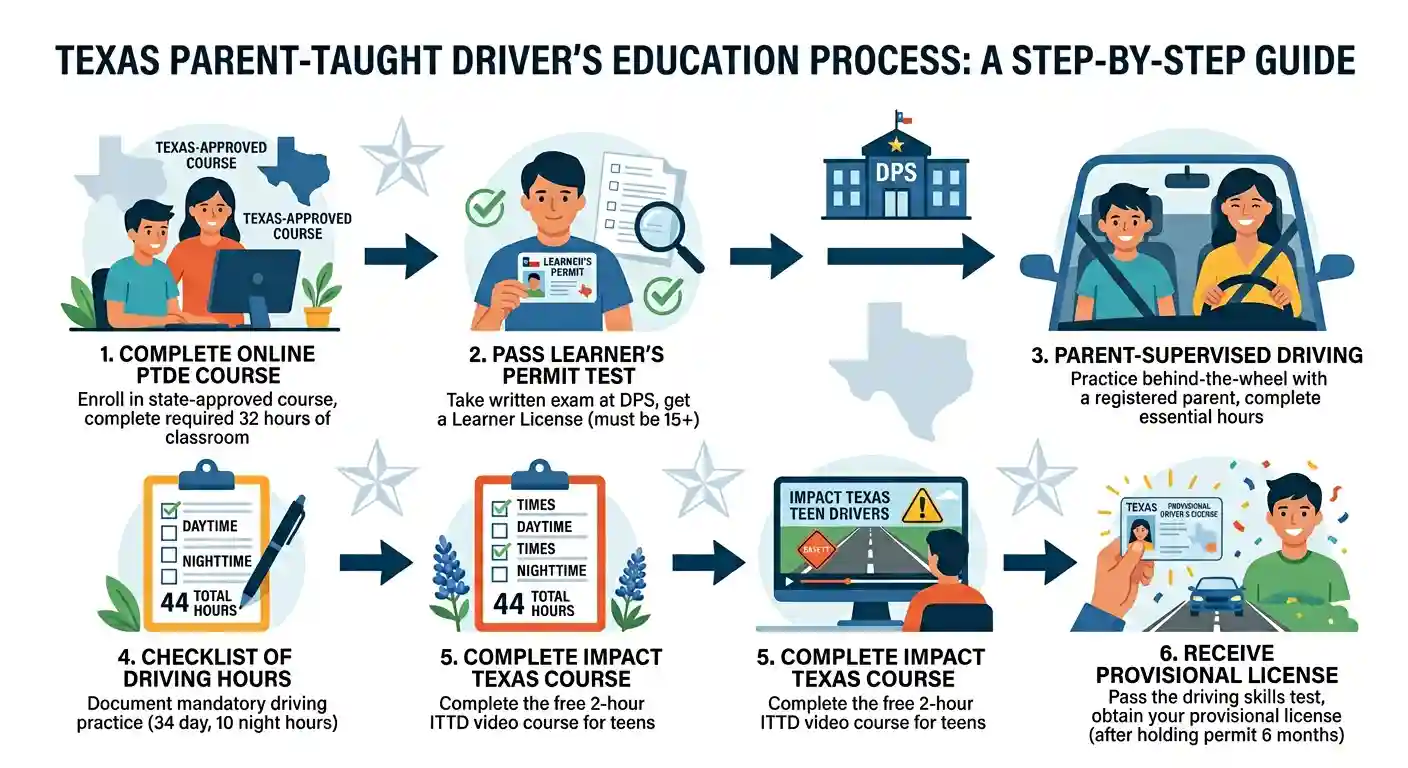
Parent-Taught Driver’s Education (PTDE) is a Texas program that allows parents or legal guardians to guide their teen through driver training while completing the required classroom instruction through a state-approved online driver education course.
Unlike traditional driving schools, the Parent-Taught program allows families to combine online driver education with supervised driving practice, giving teens the flexibility to learn at their own pace while gaining real-world experience behind the wheel.
All Parent-Taught Driver’s Education programs must be approved by the Texas Department of Licensing and Regulation (TDLR) and follow requirements recognized by the Texas Department of Public Safety (DPS). Families can verify approved providers using the TDLR approved driver education course search.
Step-by-Step: How Parent-Taught Driver’s Ed Works in Texas
Register for the Parent-Taught Driver’s Ed Program
Before beginning, the parent instructor must register with the state by completing the DL-92 Parent-Taught Driver Education Affidavit.
This confirms the parent or guardian is eligible to supervise the training.
Requirements include:
Being the teen’s parent, legal guardian, or court-appointed guardian
Holding a valid driver license
Meeting Texas eligibility requirements to supervise instruction
Helpful guide:
Texas Parent-Taught Drivers Ed Requirements
Enroll in a State-Approved Online Driver Education Course
The first 6 hours of instruction prepare students for the Texas learner’s permit written test.
Pass the Texas Learner’s Permit Test
After completing the initial course modules, teens take the DPS knowledge test.
Many online programs allow the test to be completed within the course.
Once passed, students receive a certificate that allows them to apply for their Texas learner’s permit at the DPS.
Helpful guides:
Texas Written Driving Test
What Is a Texas Learner’s Permit?
Begin Behind-the-Wheel Driving Practice
After receiving the learner’s permit, teens begin supervised driving practice. Texas requires structured driving practice that includes both observation and behind-the-wheel training. Learn more about these requirements in How Many Driving Hours Are Required for Driver’s Ed?.
Texas requires:
44 hours of supervised driving
including 10 hours at night
These hours include both observation and behind-the-wheel instruction as required by Texas driver education law.
Completion is required before scheduling the DPS road test.
Apply for a Texas Driver’s License
Once all requirements are met, teens may apply for their Texas provisional driver license.
Requirements include:
completing the driver education course
holding a learner’s permit for at least 6 months
finishing supervised driving hours
completing the ITTD course
Students will also receive aDE-964 driver education certificate, which verifies completion of the driver education program and is required when applying for a Texas driver license.
Benefits of Parent-Taught Driver’s Education
Many Texas families choose the PTDE program because it offers:
flexible scheduling for busy families
personalized driving instruction
the convenience of online classroom learning
the ability to practice driving in familiar environments
Parents also gain direct involvement in helping their teen develop safe driving habits.
Start Parent-Taught Driver’s Ed the Easy Way
Virtual Drive of Texas offers a TDLR-approved Parent-Taught Driver’s Education course designed to guide families through every step of the licensing process.
Our program includes:
step-by-step guidance through the Texas driver licensing process
preparation for the learner’s permit test
structured behind-the-wheel driving logs
certificates required by DPS
Explore the course to start your teen’s driver education journey with confidence.
Parent-Taught Driver’s Education (PTDE) allows a parent or qualified adult to supervise a teen’s driver training while the classroom portion is completed through a TDLR-approved online driver education course. Teens begin by registering for the program, completing the first six hours of coursework, and passing the Texas learner’s permit test. After receiving a permit, they log required driving hours with a supervising instructor, complete the Impact Texas Teen Drivers course, and apply for their Texas driver’s license.
How behind-the-wheel driving time is logged in Texas depends on the type of driver education program a teen is using. In Parent-Taught Driver Education, the parent instructor uses the official course log and guide to track each supervised driving session. In Instructor-Led Driver Education, the licensed driving school or affiliated instructor documents the required in-car lessons, while the additional 30 hours of practice driving are monitored by the parent or guardian, including 10 hours at night.
What is My Role as a Teen Driver’s Ed Student?
As an online driver’s ed student in Texas, your role is to engage actively in the learning process to build the knowledge and skills for safe, responsible driving. Key aspects of your role include:
Self-Motivation: Stay committed to completing the course by setting study goals and dedicating time to finish each module.
Active Participation: Engage with lessons, watch videos, and complete quizzes to reinforce essential driving concepts.
Follow Guidelines and Deadlines: Adhere to course guidelines, complete modules on time, and follow instructions for assessments.
Seek Clarifications: Ask questions if needed, using available resources to fully understand driving laws and safety practices.
Practice Responsible Online Behavior: Maintain professionalism in interactions with course materials and instructors.
Prepare for Exams: Take assessments seriously by reviewing content, practicing sample questions, and seeking help if necessary.
Apply Knowledge in Real Life: Start relating what you learn to real-world driving scenarios, focusing on responsible driving behaviors.
What Are My Responsibilities as an Online Parent-Taught Driving Instructor for My Teen?
If you’ve chosen online parent-taught driver’s ed, your role is straightforward. A quality course will guide you and your teen through the required 24 hours of classroom instruction, leaving you to simply monitor progress and sign off on course completion.
As the in-car instructor, you’ll supervise 7 hours of in-car lessons, 7 hours of behind-the-wheel practice, and an additional 30 hours of driving experience, including 10 nighttime hours. A well-structured course provides prompts and guidance to help you through each step.
Once completed, bring the required forms to the Texas driver’s license office, sign off on the paperwork, and submit it. You’ll then wait as your teen takes the final driving test to earn their license.
What If I Prefer Someone Else to Teach My Teen Behind the Wheel?
Now, parents or guardians who prefer not to teach behind-the-wheel (BTW) skills can still enjoy the flexibility of online learning. A recent Texas law allows individuals over 25 with a valid driver’s license—such as a sibling, cousin, or family friend—to conduct BTW instruction for teens. Alternatively, commercial driving schools work with online providers to offer a hybrid approach, combining 24 hours of online classroom instruction with professional in-car training.
This hybrid model merges the benefits of parent-taught and commercial drivers ed, providing an affordable and flexible option for families who prefer not to handle the BTW instruction themselves.
How Do I Know if I’m Eligible to Be a Parent Taught Driving Instructor?
The TDLR website provides step-by-step instructions for registering as a parent-taught driving instructor. You can check your eligibility to teach your student here.
Does My Teen Need Auto Insurance?
While your teen holds a learner’s permit, they can be covered under your vehicle insurance as long as they’re still a student and unlicensed. Once they obtain a driver’s license, they’ll need liability insurance in their own name.