

How to Drive a Car Step by Step: A Beginner’s Guide for Texas Drivers
Learning how to drive a car step by step doesn’t have to feel overwhelming. Every confident driver on the road started exactly where you are right now, sitting in the driver’s seat for the very first time, wondering what to do next.
This guide walks you through the basics of operating a vehicle, from adjusting your seat and understanding the controls to making your first turns and building toward real driving situations. Virtual Drive of Texas has helped thousands of new drivers build safe habits since 2004, and our TDLR-approved courses pair with this hands-on knowledge to give you a well-rounded start behind the wheel.

Step 1: Prepare Before You Start Driving
Before you turn the key or press the ignition button, take a few minutes to set yourself up for a comfortable, safe experience. Rushing through this part is one of the most common mistakes new drivers make, and it creates problems that follow you throughout the entire practice session.
Get Comfortable in the Driver’s Seat
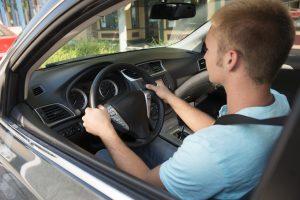
Sit down and adjust your seat so you can reach both the brake and gas pedals without stretching. Your knees should be slightly bent when pressing the pedals all the way down. If the steering wheel is adjustable, position it so your hands rest naturally at about the 9 and 3 o’clock positions without your shoulders lifting off the seatback.
Next, set your mirrors. The rearview mirror should frame the entire rear window. Each side mirror should show just a sliver of the side of your car, with the rest of the view covering the lane beside you. Good mirror positioning reduces blind spots and gives you a wider picture of what’s happening around you.
Fasten your seatbelt. In Texas, all vehicle occupants are required to buckle up, and as the driver, you’re responsible for making sure everyone in the car is properly restrained before you go anywhere.
Know Your Surroundings and the Dashboard
Take a moment to look around the vehicle. Identify where the turn signal lever is, how the headlights switch on, and where the windshield wipers are controlled. Find the hazard light button. Glance at the dashboard gauges to understand what the fuel level and temperature readings look like under normal conditions.
If you’re practicing in a parking lot, scan the area for light poles, curbs, shopping carts, and other obstacles. If you’re on a quiet residential street, note any parked cars, driveways, or intersections nearby. Knowing your environment before you start moving is a habit worth building from day one.

Step 2: Start the Car and Learn Basic Controls
With your seat, mirrors, and seatbelt sorted, you’re ready to start the vehicle. This is where many new drivers feel a surge of nerves, but the process itself is simple once you know the order.
Starting the Engine
Place your right foot firmly on the brake pedal. If the car has an automatic transmission (which most vehicles in the United States do), confirm that the gear selector is in Park. Then either turn the ignition key forward or press the push-button start. The engine will turn over and settle into an idle hum.
Keep your foot on the brake. There’s no rush to move anywhere yet.
If you’re learning in a car with a manual transmission, the process is a little different. You’ll press the clutch pedal with your left foot and the brake with your right, confirm the gear stick is in neutral, and then start the engine. Manual driving is a separate skill set, and most beginners start with an automatic car before exploring a stick shift later.
Getting a Feel for the Pedals
While the car is still in Park, gently press and release the gas pedal a few times to hear how the engine responds. You don’t need much pressure at all to make the RPMs climb. This is an important lesson early on, because many new drivers press too hard on the accelerator when they first start moving and end up lurching forward.
Now do the same with the brake. Press it gradually and notice how much pressure it takes to hold the car still, compared to how the pedal feels when you push it harder. Smooth, gradual inputs on both pedals are the foundation of comfortable driving. Jerky stops and jackrabbit starts come from pressing too hard, too fast.

Step 3: Move the Car and Practice Stopping
Here’s the moment that matters. You’re about to make the car move under your control for the first time. Take a breath, keep both hands on the steering wheel, and follow this sequence.
Moving Forward
With your foot still on the brake, shift the gear selector from Park into Drive. You’ll feel a slight engagement as the transmission connects. Slowly release the brake pedal, and the car will begin to creep forward on its own. This is called “idle creep,” and in a flat parking lot, it’s enough to get you rolling without touching the gas pedal.
Once you’re comfortable with the creep speed, lightly press the accelerator with your right foot. Just a little. You’re aiming for a walking pace, not highway speed. Focus on keeping the steering wheel steady and the car pointed straight.
Steer with smooth, small adjustments. New drivers tend to overcorrect, turning the wheel too far one way and then too far back. Relax your grip and let the car track straight. If you’re in an empty parking lot, drive in a straight line across the lot and then come to a gentle stop at the other end.
Stopping Safely
When you want to stop, take your foot off the gas pedal and press the brake. Press the brake gradually, not all at once. The car should slow smoothly and come to a complete stop without jolting you or your passengers forward.
Practice this a few times: accelerate gently, drive in a straight line, and brake to a smooth stop. Repeat until the transition between gas and brake feels natural and predictable. When you’re finished with a practice session, shift into Park and engage the parking brake before turning off the engine.

Step 4: Practice Steering, Turning, and Basic Maneuvers
Once straight-line driving and stopping feel comfortable, it’s time to add steering and turning into the mix. This is where your driving skills really start to take shape.
Turning Basics
Start with wide, slow turns in your practice area. Approach the point where you want to turn, slow down, and begin rotating the steering wheel smoothly in the direction of the turn. Look where you want the car to go, not at the curb or obstacle you’re trying to avoid. Your hands will naturally follow your eyes.
After completing the turn, gradually straighten the wheel to return the car to a straight path. Practice both left and right turns until the motion feels controlled rather than uncertain.
For tighter turns, you’ll need to slow down more before starting the turn and apply more steering input. Speed and steering are always connected: the slower you go, the more you can turn, and the faster you go, the gentler your steering should be.
Reversing
Put the car in Reverse and turn your body to look over your right shoulder through the rear window. Use your mirrors as a supplement, but get in the habit of looking behind you physically. Back up slowly, using idle creep or very light accelerator pressure. Steer gently, remembering that the back of the car moves in the direction you turn the wheel, which can feel counterintuitive at first. Practice backing up in a straight line, then try backing into a parking space. These are skills you’ll use constantly as a licensed driver.
Parking
Pull-through parking (driving forward into a space) is the easiest place to start. Line up your vehicle with the space, turn in slowly, and straighten the wheel once you’re centered. As your confidence grows, work on backing into spaces and eventually parallel parking, which is tested during the Texas road test.
Throughout these maneuvers, check your mirrors and blind spots before each move. Building that awareness now will serve you well when you transition to busier roads with other vehicles, pedestrians, and cyclists around you.
Step 5: Transition to Real Driving Situations
Parking lot practice builds the mechanical foundation. But driving on actual roads with traffic, signals, and other people requires a different level of awareness. Make this transition gradually, starting with quiet residential streets before progressing to busier roads.
Reading Traffic Signs and Signals
Before heading onto public roads, make sure you know the basic categories of traffic signs. Regulatory signs (like stop signs and speed limits) tell you what you must do. Warning signs (like curve ahead or deer crossing) alert you to upcoming conditions. Guide signs (like highway exits and distance markers) help you find your way.
Study the Texas Driver’s Handbook for a full breakdown of sign shapes, colors, and meanings. This is also covered very thoroughly in the driver education courses in Module 1, Lesson 3. A strong grasp of these signs will help you react correctly without hesitation while driving.
At intersections, watch the traffic signals and understand right-of-way rules. When a light turns green, look both ways before proceeding, because not every driver stops when they should. At stop signs, come to a complete stop, yield to vehicles and pedestrians who arrived before you, and proceed only when it’s clearly safe.
Maintaining Safe Following Distance
On public roads, keep at least three to four seconds of distance between you and the vehicle ahead of you. Pick a fixed object on the roadside. When the car in front of you passes, count the seconds until you reach the same point. If you count less than three, ease off the gas and create more space.
Increase that gap in rain, in heavy traffic, or when following large trucks whose drivers can’t see you in their mirrors. Tailgating is one of the most common causes of rear-end collisions, and new drivers benefit from giving themselves extra room to react.
Defensive Driving From Day One
Defensive driving means expecting the unexpected. Watch for cars pulling out of driveways, pedestrians stepping off curbs, and vehicles changing lanes without signaling. Scan the road ahead of you, not just the car directly in front of your bumper.
Avoid distractions. Put your phone away before you start driving. If you need to change music, adjust your GPS, or respond to a message, pull over to a safe location first. Texas law prohibits texting while driving for all drivers, and for those under 18 with a learner permit, any cell phone use behind the wheel is illegal.
Your Parent-Taught Driver’s Ed parent instructor materials include structured driving lessons that guide you through this progression, from parking lot basics to highway driving and complex intersections.

Conclusion
Learning how to drive a car step by step is a process, not a single afternoon. Each session behind the wheel builds on the last, and skills that feel awkward today will become second nature with repetition and patience. Start with the basics: adjust your seat, learn the controls, practice in a low-pressure environment, and work your way up to real traffic situations at a pace that feels right.
Every safe, skilled driver on Texas roads once sat in the driver’s seat for the first time and wondered what to do next. You’re taking the right step by learning the fundamentals before jumping into traffic. Combine this hands-on practice with structured coursework, and you’ll build the knowledge and confidence to handle whatever Texas roads put in front of you.

Get Started with Virtual Drive of Texas
Teens Ages 14-17:
Enroll in Parent-Taught Driver’s Ed to build a strong foundation in safe driving with our comprehensive TDLR-approved course. Includes 24 hours of online instruction, complete in-car training materials for parents, the DPS written test, and ITTD certification. Just $59.95 (regularly $99.95).
Adults Ages 18-24:
Enroll in Adult Driver’s Education to complete your required 6-hour course and develop the knowledge you need before getting behind the wheel. Includes the DPS written test and instant certificate download. Available in English and Spanish. Just $38.00 (regularly $78.00).
Essential Resources:
- Parents’ Guide to Teaching Driver Education
- Texas Learner’s Permit Guide
- In-Car Course Details
- Take Our Free DPS Practice Test
- Download the Texas Driver’s Handbook
Questions About Learning to Drive? Contact our Texas-based support team at (833) 3-VDRIVE. We’ve helped thousands of new drivers get started, and we’re here to help you, too.